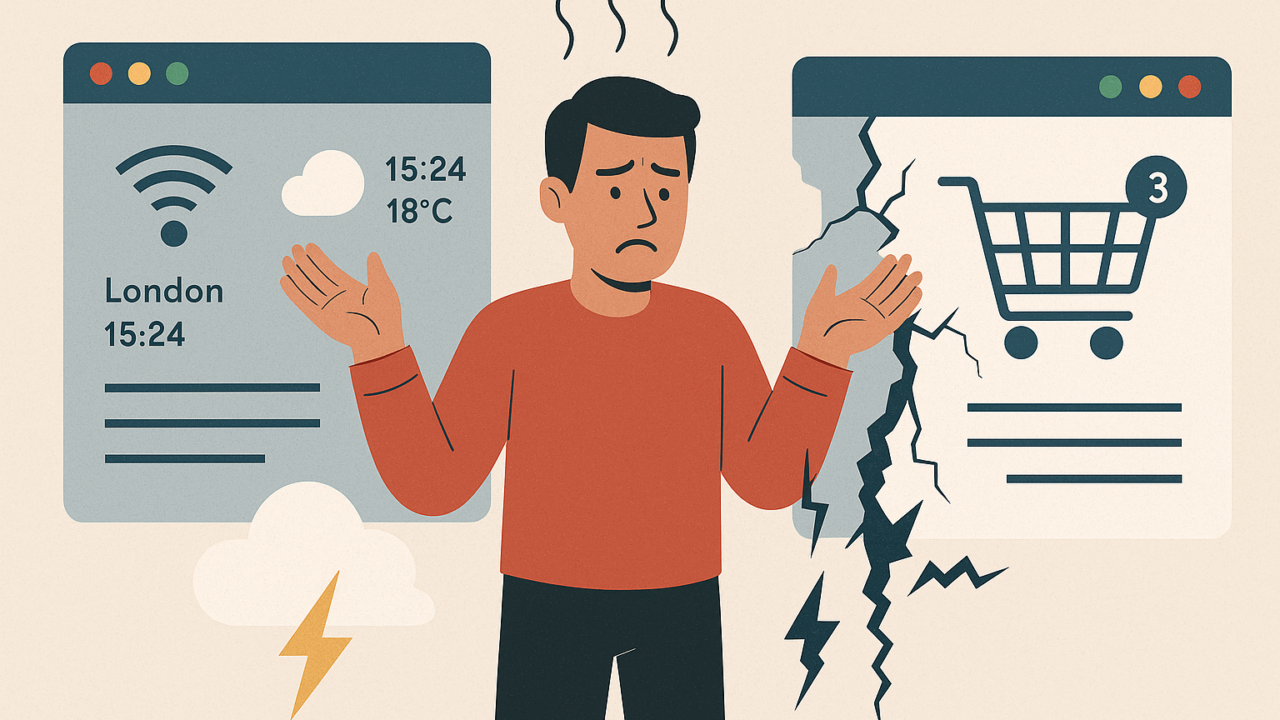

For most people, the internet feels permanent. Messages send instantly, payments clear in seconds, and work, school, and public services depend on constant connectivity. When outages happen, they feel shocking—almost unnatural—because modern life assumes the internet is always on.
But the internet is not a single, indestructible system. It is a layered network of physical cables, data centers, routing protocols, software platforms, and human decisions. Despite decades of engineering aimed at resilience, the internet remains fragile in ways most users only notice when something breaks.
Understanding what happens when the internet goes down reveals not just technical weaknesses, but deeper trade-offs in how digital infrastructure is designed, managed, and relied upon.
The Problem: Resilient by Design, Vulnerable in Practice
The internet was designed to survive partial failure. Its decentralized architecture allows data to reroute around damaged paths, keeping information flowing even when parts of the network fail.
However, resilience does not mean invulnerability.
Recent large-scale outages have exposed weak points in global connectivity. Reporting by the Associated Press has documented how undersea cable damage—caused by ship anchors, fishing activity, or regional conflict—can disrupt internet access across multiple countries. At the same time, cloud service outages have taken down thousands of websites at once, even when physical networks remained intact.
The impact is greater today because the internet now underpins essential systems. Banking, healthcare, logistics, education, and government services depend on uninterrupted connectivity. When the internet goes down, the effects are no longer limited to inconvenience—they can quickly become economic and social emergencies.
How the Internet Actually Works—and Fails
Physical Infrastructure Still Matters
Despite its digital appearance, the internet is physical. Nearly all international data travels through undersea fiber-optic cables. Infrastructure analysts cited by TeleGeography explain that while redundancy exists, cable damage can still slow or disrupt traffic—especially in regions with limited alternate routes.
On land, data centers process and store massive volumes of information. These facilities rely on power grids, cooling systems, and network access. Heat waves, fires, floods, or power failures can knock them offline, sometimes with global ripple effects.
Routing and Human Error
Data moves across the internet through routing agreements between thousands of independent networks. Routing protocols help traffic find alternate paths when failures occur.
In practice, misconfigurations can cause traffic to disappear or loop endlessly. Several major outages over the past decade were caused not by broken hardware, but by human error in routing updates, which propagated rapidly across networks. These incidents highlight how automation amplifies both efficiency and mistakes.
Cloud Concentration
While the internet’s foundations are decentralized, many modern services are not. A large share of websites and applications rely on a small number of infrastructure providers such as Amazon Web Services, Cloudflare, and Google Cloud.
This concentration improves efficiency and reliability for individual companies but increases systemic risk. When one provider experiences an outage, thousands of unrelated services can fail simultaneously. Centralization lowers costs, but it expands the blast radius of failure.
Automation and Complexity
Modern infrastructure relies heavily on automation. Systems scale traffic automatically, deploy updates continuously, and respond to demand in real time.
Research on internet resilience published in ScienceDirect notes that increasing system complexity makes failures harder to diagnose and resolve, particularly when responsibility is distributed across multiple organizations.
Trade-Offs: Efficiency Versus Resilience
The fragility of digital infrastructure is the result of deliberate trade-offs rather than technical oversight. In pursuit of efficiency, digital systems have enabled faster deployment of services, lower infrastructure costs, global scalability, and simpler operations for organizations. These gains have fueled rapid innovation and widespread access to online services.
At the same time, these choices have introduced new vulnerabilities. Greater efficiency has often meant increased centralization, creating single points of failure and reducing visibility into complex system dependencies. Resilience has also become uneven across regions, with outages having a larger societal impact where redundancy is limited.
Academic research on internet governance notes that responsibility for resilience is fragmented among governments, network operators, and private firms, making coordinated responses during major outages difficult and slow.
Why Internet Outages Matter More Now
In the early days of the web, outages usually meant slow email or inaccessible websites.
Today, the consequences are far more serious. Connectivity failures can interrupt emergency communications, disrupt hospital systems, freeze payment networks, ground flights, and cut off access to government services.
As societies continue to digitize essential functions, internet outages have become systemic risks with real-world consequences, rather than mere technical inconveniences.
Designing for Failure, Not Perfection
Eliminating outages entirely is unrealistic. A more practical goal is to design digital systems that can fail gracefully without causing widespread disruption.
This requires diversifying infrastructure providers, investing in regional redundancy, and improving transparency when outages occur, rather than treating failures as exceptional events.
As the internet becomes inseparable from public safety and economic stability, connectivity must be approached as critical infrastructure, with resilience embedded as a core design principle rather than an afterthought.
Looking Ahead: Resilience as a Design Choice
As dependence on the internet deepens, the question is no longer whether outages will happen, but how societies prepare for them. Connectivity has quietly become as critical as electricity, water, and transportation, yet it is still governed largely by market incentives rather than public-interest standards. This gap between reliance and regulation leaves communities exposed when failures occur.
Building a more resilient internet will require coordination across governments, private companies, and infrastructure operators—groups that do not always share the same priorities.
Investments in redundancy, transparency, and regional capacity may not always deliver immediate financial returns, but they reduce long-term systemic risk. Just as importantly, clearer communication during outages can preserve public trust even when systems fail.
Ultimately, the fragility of digital infrastructure is not a purely technical problem. It is a reflection of choices about efficiency, cost, and convenience. As the internet continues to underpin economic activity and civic life, resilience must be treated not as an optional feature, but as a shared responsibility.
The future stability of the digital world will depend less on eliminating failure—and more on designing systems that can withstand it, recover quickly, and fail without bringing everything else down with them.